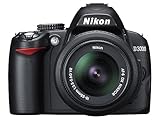
The Nikon D3000 is an entry-level DSLR, but don’t let the term fool you. When you place the label “Entry Level” on a camera, it might call to mind a camera with no frills, limited uses, and little more to offer than an automatic shooting experience.
This has been disproved by the latest crop of cameras released in the past two years, and the D3000 continues to set the bar high for an entry-level camera.
This new generation of point-and-shoots and entry-level DSLRs not only push the boundary of low-light performance and mega resolutions, they give that power to a whole new audience of beginning photographers.
Not only do DSLRs offer you manual control over shooting, they give you the advantage of using different kinds of lenses. It’s important to remember when buying a DSLR that you’re also buying into a system of lenses, not just a camera. The power of having a DSLR is that you can place any of your old lenses onto a new camera body in the future.
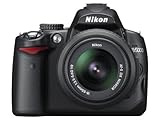
Enter the Nikon D3000, a new entry-level DSLR with a 10.2 megapixel DX-format CCD APS-C image sensor, 11-point Autofocus system with 3D tracking (which comes on the higher-end D5000 and D90), Active D-Lighting and an AF-S DX NIKKOR 18-55mm f/3.5-5.6 VR lens for $599.
The Nikon D3000 feels and looks exactly like the other DSLRs from Nikon, and is only different from the D90 and D5000, both higher-end models, by a few tenths of an inch. The D3000 measures 5.0×3.8×2.6 inches while the D90 is 5.2×4.1×3.0 inches, though the D3000 weighs a bit less at 1 lb 1 oz, making the Nikon entry-level to prosumer DSLR models almost identical in shape and size as well as overall appearance.
First time DSLR users will enjoy the Guide Mode. It literally walked us through different shoot scenarios via the fixed 3″ LCD screen. An excellent tool, its step by step instructions allowed my niece to move from the operating booklet in no time.
The Nikon D3000 is paired with a Nikkor 18-55mm AF-S DX lens. It will operate with any Nikkor DX and AF-S lens.
Nikon makes it really simple with a thumb dial for tweaking aperture and shutter speed. Metering, focus modes, and exposure compensation are easily controlled via the menu. The D3000 does not shoot in video mode. This model easily shoots over three frames per second in continuous mode. The 3D tracking sensor operates quite well in low lighting.
For a limited time, purchase Nikon’s next-generation D300s digital SLR and save 50% on the powerful, pocket-sized Coolpix S710.
Here’s some clue on this bast-Nikons-deal!
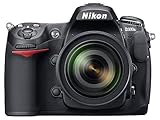
Nikon D300s
The Nikon D300s updates the excellent D300 as Nikon’s flagship DX format DSLR. It combines the performance and handling panache of its predecessor with high-definition video capability.
The Nikon D300 made a impressionable impact when it was first launched 2 years ago making it the semi-professional DSLR to beat. And in many respects it is still the camera to beat in that class. After 2 years, Nikon deemed it is time to up the ante, which most notably includes support for 720p video capture, and launched the D300S. The D300S will replace the D300 the same way the D70S replaced the D70 and it is looking to hold on to that high-end non-full frame slot for a long time.
Design
In line with tradition, the Nikon D300s
looks just like its older counterpart. The most notable addition is the three small holes just underneath the model number which is a microphone, a feature last seen in the D90.
Many of the new features on the Nikon D300s
are those that are already featured on recent Nikon DSLRs like virtual horizon from the D3 and movies from the D90. But one genuine new feature is the inclusion of contrast-detection autofocus that operates while in movie mode. This is a first for a Nikon DSLR.
There are some changes to the connection ports on the left. The HDMI output is now a mini HDMI port with a smaller Type-C specification.
Also new are twin card slots – one Type I CompactFlash and one SD/SDHC – with a full complement of write options. Either slot can be designated the primary one, with the secondary slot used for Backup (each photo is written to both cards) or Overflow (when the primary card is full the camera switches to writing to the secondary card). In addition, the Nikon D300s
can be configured to store NEFs on one and JPEGs on the other, plus photos can be copied between the cards too. Also interesting is the support for the newer Wi-Fi capable memory cards.
Many changes can also be found on the back where there is a repositioned “Lv” button which activates the Live view feature. Just below that is the “Info” which brings the Nikon D300s
up to the same level of usability as the D90. The dedicated “Info” button is extremely useful in that it lets you get to every camera setting and menu item using only your right hand.
Performance
The Nikon D300S is responsive and the improved frame rate is also a bonus. Still image focusing is fast and the AF viewfinder confirmation display is superb, the improved frame advance rate helps with fleeting subjects but seems to suffer when shooting uncompressed RAW files.
Metering and white balance are almost flawless. In terms of white balance, using auto WB setting seems to have a slight orange cast, but if you pick the correct WB setting for the picture by using a custom setting, the D300S renders natural looking images. Metering is excellent with the 3D Color Matrix.
In terms of image noise, shots in near darkness at ISO 1600 provide images with a good balance between image detail and noise. However, pushing ISO to 6400 results in images with an obvious level of noise.
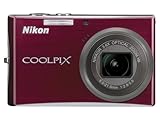
Nikon Coolpix S710
The Nikon Coolpix S710 is a 14.5 megapixel digital camera. It has a 3.6x wide angle lens. One advantage it has over other smaller compacts is the fact it also has manual exposure modes. Other features include image stabilisation and a 3 inch LCD screen.
The Nikon Coolpix S710 is a compact that’s suited to night-time photography. Not only does it feature a 3-inch LCD screen that’s bright and easy to view in low light, but it also comes equipped with a generously high ISO of up to 12800 (allowing you to capture images in lower light without the need for flash) as well a Vibration Reduction feature to cut down on unsightly image wobble.
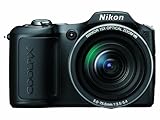
It goes like this: the Nikon Coolpix L100 is a “bridge-style” camera that combines ease of shooting with the compositional freedom of a 15x zoom lens that covers everything from 28mm wide-angle to 420mm super-telephoto shooting.
As part of the ‘Life’ series, the Nikon Coolpix L100 sits in the Nikon range towards the bottom end. Still, a 10Mp sensor and 15x optical zoom aren’t anything to be sniffed at. On the surface it does seem that the only reason this camera was released was to satisfy the consumers who wanted a big zoom and nothing else.
The Nikon Coolpix L100 holds in a 15x optical zoom with Vibration Reduction for the zoom and distortion control for the wide shots.
On the back is the expected 3in LCD screen and very little else for simplicity’s sake.
Again, a few buttons are sat to the right of the screen for changing the mode you’re in or selecting macro, flash and drive options. The main modes are brought up for selection when you press the camera button. Easy auto makes everything point and shoot to a level I don’t normally experience. In this mode, the main menu allows you to change the resolution. That’s basically it for that mode, if you want to do anything else, you’ll have to choose the normal auto mode found at the bottom of the list.
There are only fourteen modes in the scene menu which is a little unusual for a camera that essentially takes control away from you. This could be down to the predictive auto systems that all cameras are having installed in them since Panasonic developed it. It works in the normal auto system and detects what type of photograph you’re taking then adjusts the mode the camera is in to suit. Of course, it can’t tell when you’re in a museum so there’s an option for that in the scene selections.
Looking at the menu and it’s just as simple as the rest of the Nikon Coolpix L100.
In auto mode there’s only two tabs to choose from for recording options and set up. You can also change the resolution, white balance, drive modes, colour options and take advantage of the distortion control. This could be a distinct advantage with the wide angle lens as it will cause distortion otherwise they wouldn’t include the feature on the camera.
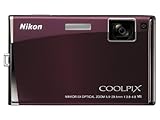
The Nikon Coolpix S60 is the newest generation of ‘point and snap’ camera, a perfect travel mate!
Roughly the same size (though twice as thick) as the revolutionary iPhone, the appearance and ergonomics of Nikon’s Coolpix S60 will be reassuringly familiar to Apple aficionados.
While the S60 comes equipped with a somewhat standard feature set, what makes it an easy, fun camera to shoot and show is its intuitive and responsive 3.5-inch touchscreen viewfinder.
Some of the features include a massive 10 mega pixel resolution which will enable you to print fantastic quality pictures of up to 16 x 20 inches as well as a 5x optical zoom lens with ‘VR image stabilization’. It has a 3.5 inch high resolution touch panel LCD screen and automatically adjusts the ISO up to 3200. One of the other great things is that you can save to an expandable memory slot in the form of SD/SDHC.
The Nikon Coolpix S60 is small enough to slip into a pocket and has a slightly longer than standard 5x zoom lens for this type of camera.
This is a very good looking camera and has obviously been built for easy usage with the 20MB of internal memory, SD card expansion slot and JPEG, AVI and WAV formats.
The Nikon Coolpix S60 has VR image stabilization which reduces camera shake as well as smile shutter and blink warning which will let you know when a subjects eyes are closed so you can retake the picture.
The Nikon Coolpix S60 is inline with a lot of other smaller digital cameras when you increase the ISO rating. The noise levels at ISO 400 are noticeable, but if it’s the only way to get a picture, then it levels are acceptable.
We like the macro shot. It is very clear and has great definition.
Ultrazoom compact cameras have come a long way, really long if you consider that two out of three of these sport a 24x zoom lens.
This means, in 35mm jargon, an equivalent 26-624mm zoom. The Olympus SP-590UZ, goes even further, up to 26x (676mm equiv.)!
All three have image stabilization and vibration reduction features; they all reach the 12 megapixel peak and may give you something to think about when choosing your next camera: an ultrazoom compact with DSLR-level features.
Which is the best? Fair bet… each one has its own strong points, so check out for yourself!
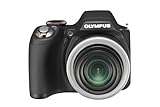
The Olympus SP-590UZ: with a 26x optical zoom lens covering a remarkable 26-676mm focal length range, 10fps sequential shooting, and a 12 Megapixel CCD, nothing can escape the scrutiny of the SP-590UZ.
Photographers using the latest Olympus Ultra Zoom can further increase the power of its lens to 130x using the optional TCON-17N Teleconverter.
Luckily, Dual Image Stabilisation is on hand to protect photos from blur caused by camera shake, and Shadow Adjustment Technology has been included to bring out details hidden in darker areas of the picture.
So when photographers view their results on the camera’s 6.9cm/2.7” HyperCrystal II LCD, they know that they’ll be picture perfect.
The Pentax X70 12MP CCD Digital Camera with 24x Optical Triple Shake Reduction Zoom and 2.7 inch LCD is an all-purpose digital compact camera featuring a high-magnification optical 24x zoom and 6.25x digital zoom lens.
The camera has approximately 12 effective megapixels and utilizes a 1/2.33-inch CCD image sensor.
Its lens focusing distance is 4.6 - 110.4mm (approx. 26-624mm in 35mm format) with an aperture range of F2.8(W)-F5.0(T). The X70 is able to record up to 1280 resolution video and has an ISO sensitivity of up to 6400.
It has Motion Blur Reduction, Hi-sensitivity anti-shake mode (Digital SR), and Movie shake reduction mode (Movie SR).
The camera has a 33.6 MB built-in memory with support for SD/SDHC Memory Card expandibility.
The Pentax X70 has a 2.7-inch 230K AR coating LCD display and an electronic viewfinder (200K dots) and auto and manual focus, macro shots, exposure control, exposure compensation, scene mode, playback mode, shutter speed of 1/4000-1/4 seconds, built-in flash and “Red-eye” reduction. The Pentax X70 is powered by a rechargeable D-LI92 lithium-ion battery, measures 110.5×82.5×89.5mm and weighs 390g (without battery and SD memory card).
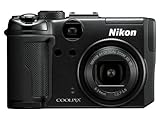
The Nikon Coolpix P90 12.1MP Digital Camera with 24x Wide Angle Optical Vibration Reduction (VR) Zoom and 3 inch Tilt LCD is among the first Nikon models to advertise the manufacturer’s “four-way” Vibration Reduction image stabilization concept. In addition to optical/mechanical image stabilization, the Nikon P90 utilizes motion detection (which detects subject motion and adjusts shutter speed and/or ISO accordingly), reduced-res high-sensitivity shooting at up to ISO 6400, and Nikon’s Best Shot Selector (which “automatically takes up to 10 shots while the user presses the shutter, and saves the sharpest image”).
Shooting Modes for All
Two new shooting modes on the P90 seek to expand the camera’s utility for different user groups. Aimed at soccer moms and serious shooters alike, the Nikon P90’s Sport Continuous mode captures up to 45 reduced-resolution shots at an outrageously fast 15 fps. Family photographers are also served by a new Smart Portrait System, grouping several auto exposure technologies (including blink detection, smile detection, face detection, and red-eye reduction) for easier access when taking shots of friends and family.
In the interest of enthusiast appeal, the P90 also packs in the typical P/A/S/M manual exposure modes, as well as an electronic viewfinder.
The Nikon P90 weighs in at just over a pound so it didn’t feel like we were shackled to a mid-level DSLR. The weight reduction can be attributed to the Nikon P90’s plastic body. It was obvious that Nikon sacrificed a little structural integrity in exchange for additional controls and features.
Articulating Screen: in this case, though, the big news is that the P90’s screen is articulating (Nikon calls it “Vari-Angle”), allowing the display to be tilted “as much as 90 degrees upward or 45 degrees downward,” according to the manufacturer.
The best three ultrazoom compact cameras around: now it’s up to you to choose!
Long-awaited, spotted in VIP-like photos, so much rumored but now it’s here: the new Nikon D5000!
Where to place it?
It’s likely to be placed in between the D60 and the D90… and eventually in front of just launched Canon EOS 500D/Rebel T1i!
Features?
Nikon’s EXPEED CMOS sensor, 12,9 Megapixel (quite a standard for Nikon’s DSLR lineup) and HD 720p video recording @24 fps.
Among the (long) feature list the Nikon D5000 sports a 2.7″ display (the 230.000 pixel one, not the Nikon D90’s gorgeous one) literally with a twist!
The LCD display tilts and swivels which, along with the enhanced Live View functions, extends shooting opportunities to new (practical) levels.
Live View, by the way, can be switched on with a single dedicated button.
Moreover, the Nikon D5000 gives us ISO sensibility 200 up to 3200, 11-points autofocus with 3D focus tracking and set of retouch tool for in-camera photo adjustments.
An added gadget comes with the Nikon GP-1 GPS Unit, allowing globetrotters to geotag their favorite pictures/places.
One minor note comes from lenses compatibility: just like the D40/D40X/D60 crop, the Nikon D5000 is compatible with lenses with built-in autofocus motor.
Compact cameras usually sacrifice usability, features for design’s sake, to reduce weight, to be simpler.
Here’s a trio of digital cameras that may well be the perfect choice for all amateur photographers, as well as being the second best friends to photo-pros.
The sport features, accessories compatibility and megapixel count usually found in higher - DSLR cameras, so don’t judge them by from their category: they’re compact cameras on steroids!
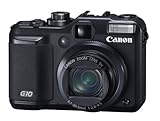
The third-generation Canon Powershot G10 is a stunning successor, loaded with uncompromising specs like 14.7 megapixels, a 28mm wide-angle lens, and Canon’s new DIGIC 4 Image Processor for notably improved face and motion detection. This is a camera that supports and nurtures creativity, with a full range of shooting and recording modes and compatibility with exciting accessories including Speedlite flashes.
Full range of shooting and recording modes including RAW + JPEG
The Canon Powershot G10’s RAW mode lets you shoot images without JPEG compression. It gives you clearer images and complete creative control in editing. RAW images are transferred directly to the computer where they can then be edited using image adjustment software or a processing application to adjust your images as you please. The camera can also be set to allow the simultaneous recording of both RAW and JPEG images while shooting.
Also, with 26 Shooting Modes including 17 Special Scene Modes, you’re ready for whatever shot comes your way.
The Canon Powershot G10 gives you an extra-large 3.0-inch LCD screen for excellent control when framing your shots. But size is only part of the story. Canon’s PureColor LCD II offers more spectacular color, resolution and contrast even at an angle (compared to PureColor LCD). The screen is highly durable and easy to see in any light with a scratch-resistant, anti-reflective coating. It is a perfect feature for gathering friends and family around to see your images.
The PowerShot G10 is compatible with the Speedlite EX series that is for all EOS series SLR cameras. Attach a Speedlite 580EX II to the hot shoe, then you can set and control the flash on the “Flash Control” menu in the camera. With the 580EX II, the G10 is given extra functions such as autoflash metering, FE lock and Flash exposure compensation; continuous shooting with external flash. Also Canon’s Speedlite Transmitter ST-E2 enables you to have multiple slave flashes and wireless control. A Tele Coverter lens designed for the G10 and High-Power Flash designed for all PowerShot cameras are also available.
Designed for easy, creative shooting, and high-performance in low-light conditions, the Panasonic DMC-LX3K features a F2.0 24mm Leica DC Vario-Summicron lens, 10.1 megapixels and an ultra-sensitive 1/1.63-inch CCD developed specifically for this model. By combining a high-quality lens and sensor ready for a variety of shooting conditions with a wide-range of accessories and manual controls, the DMC-LX3 is ideal for professional photographers and serious amateurs looking for a compact digital camera that furthers their creative photography.
At the heart of the Panasonic DMC-LX3K, is its 1/1.63-inch CCD. Making the intentional choice to limit the number of megapixels to 10.1 on its CCD, Panasonic was able to give more space for each pixel and also redesigned the peripheral circuits and other components to further minimize noise generation. As a result, sensitivity is almost 40 percent higher and saturation is increased by 35 percent when compared to Panasonic’s 10 MP digital cameras, giving the Panasonic DMC-LX3K outstanding image quality and a wide dynamic range, and meeting the demand for a camera that works optimally in low-light environments. The CCD is also capable of reproducing images in three aspect ratios — 4:3, 3:2 or 16:9. The new Multi Aspect mode allows the camera to take an image in all three aspect ratios simultaneously, allowing users to choose the version that best suits their needs.
Another major upgrade to the LX3 is the F2.0 24mm ultra wide-angle Leica DC Vario-Summicron lens. The F2.0 is about twice as bright as a F2.8 lens and can shoot at higher shutter speeds to capture clear, blur-free images in dimly lit environments. In addition, the 24mm lens captures approximately a 213-percent larger viewing angle than a normal 35mm camera and 136% larger compared to a 28mm wide-angle lens. The lens unit consists of eight elements in six groups with four aspherical lenses with four aspherical surfaces. As a result of the F2.0 lens, the LX3 produces high resolution and minimal distortion and artifacts — such as chromatic aberrations, ghosting and flaring.
The DMC-LX3 has the ability to record High Definition (HD) video in 1280 x 720p at 24fps. With the newly added HD component output capability, still and moving pictures can be viewed by connecting the camera to a TV via an optional component cable (DMW-HDC2). In addition, the LX3 features Image Leveling, so when a captured image “leans” to the right or left because the camera was held at a slight angle when the photo was taken, this feature rotates the image to straighten it and crops the unnecessary edges.
Nikon’s classically compact Coolpix P6000 combines 13.5 effective megapixels with a 4x wide-angle optical Zoom-Nikkor ED glass lens for stunning prints as large as 20×30 inches. Nikon’s EXPEED image processor and Image stabilization make for sharp pictures. The incredible, bright 2.7-inch LCD and optical viewfinder make it easy to compose and share pictures. Get the ultimate in control and creativity with Program, Shutter, Aperture and full Manual exposure modes. The Nikon Coolpix P6000 also has a Wired LAN port and GPS geo-tagging capability to upload your pictures to Nikon’s my Picturetown photo storage and sharing service.
What does this mean?
Simply put, wired LAN support offers easy access to the Internet for automatic and secure online image storage using the Picture Bank service of my Picturetown, which also provides the ability to send images directly to a blog or other websites. And a new built-in GPS (Global Positioning System) unit can record the location of shots when taken and attach ?geotags” with information about latitude and longitude to each image file. This adds the fun of being able to view the location on maps available in ViewNX or my Picturetown, or to edit or add geotag information.
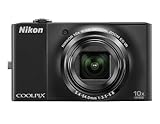
Nikon has announced its flagship compact, the classically compact Nikon Coolpix P6000 combines 13.5 effective megapixels with a 4x wide-angle optical Zoom-Nikkor ED glass lens for stunning prints as large as 20×30 inches.
Using Nikon’s EXPEED image processor and Image stabilization, the Nikon Coolpix P6000 also records RAW files in a new NRW format that can be converted in-camera or with the forthcoming Windows version of View NX or Windows Imaging Component compatible applications.
A stand-out feature is the inclusion of built-in GPS logging of the locations at which images were recorded which combined with its Wired LAN port provides geo-tagging capability to upload your pictures to Nikon’s my Picturetown photo storage and sharing service.
The perfect gift? A Nikon Coolpix S51! Your mother will like its sleek design and the Magenta (or call it pinky, if you like) nuance.
She will like too the advanced features that make it easier to take beautiful photos and to share them with friends and family!
The Nikon Coolpix S51 includes Pictmotion, which allows users to create audiovisual shows anywhere by simply selecting favorite images and movies and adding music and visual styles.
The Nikon Coolpix S51sports a 3.0-inch LCD monitor that offers a bright and large image that eases composition and viewing, even out in the sun.
Not to mention, she’ll never miss a shot with optical lens shift VR image stabilization.
You’ll like it’s Nikon quality (and now comes with a 22% saving offer!).Moth
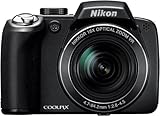
The new Nikon Coolpix P80, a new addition to its successful COOLPIX P series range, a great 10 Megapixel camera!
Designed for active photo enthusiasts with an interest in fine detail, this camera features a class-leading compact body size and a zoom lens that ranges from wide-angle to super telephoto (27-486mm equivalent in 35mm [135] format).
The Nikon Coolpix P80 sports optical VR Image Stabilization minimizes the effect of camera shake, for sharper images, and a bright 2.7-inch high-resolution LCD and electronic viewfinder to make composing and sharing pictures easier than ever.
In addition to this, the Nikon Coolpix P80 also offers manual control of exposure (shutter and aperture) and a high sensitivity rating of up to ISO 6400 for use in low light conditions. The exceptionally powerful zoom lens is capable of focusing on subjects that are as close as 1 cm, and image-shift Vibration Reduction technology stabilises the image sensor to combat camera shake.
Shutter Priority and Manual Exposure Modes give you personal control over camera operation. A new Sports Continuous Mode lets you capture up to 30 frames at up to an amazing 13 FPS!
We were wondering what was missing from PMA 2008 pre-announcements: Nikon!
Here comes the new Nikon D60, supposedly replaces the well-known Nikon D40X, features 10.2 MP and introduces a new anti-dust system, active d-lighting, a stop-motion recording mode and Expeed branding.
Active d-lighting helps in the area where most DSLRs this year will compete on: extended dynamic range. The stop-motion feature - welding together single frames into a movie - is a first-ever feature as far as we know in a DSLR.
At least three new lenses: a 16-85mm f/3.5-5.6G ED VR, the Micro Nikkor 60mm f/2.8G ED for die-hard macro enthusiast and the PC-E Nikkor 24mm f/3.5D ED offering both tilt and shift movement.
Still have to sort out the number of new Coolpix cameras upcoming; the most prominent may be the P60, a 36-180mm-superzoom compact with optical viewfinder (a rarity) that replaces the Nikon Coolpix P50 losing somehow on the optical side at wide-angle (from 28mm up to 36mm).
The P60 features M exposure mode provides full control over both the aperture and shutter speed settings.
Check the Coolpix L16/L18 for budget-savy users, the S210 (8 MP), S520 (8 MP) and S550 (10 MP).
More details coming up!
Updated! Now Nikon D60 is available for pre-order!
Nikon recently announced 8 new Coolpix digital cameras to celebrate 10 years of the compact camera brand:
- Coolpix P5100 and Coolpix P50,
- four cameras in the Style series; the COOLPIX S700, COOLPIX S510, Nikon Coolpix S51c and COOLPIX S51
- two COOLPIX cameras in the Life series, the Nikon Coolpix L15 and Nikon Coolpix L14.
The eight new cameras in the Nikon COOLPIX line include two cameras in the Performance series, the Coolpix P5100 and Coolpix P50, four cameras in the Style series, including the COOLPIX S700, COOLPIX S510, COOLPIX S51c and COOLPIX S51 and two COOLPIX cameras in the Life series, the COOLPIX L15 and COOLPIX L14.
The Coolpix P5100 will offer 12.1 megapixels, the company’s EXPEED digital image processing technology and a 3.5x Zoom-NIKKOR lens, with ISO up to 3200 and a 2.5-inch LCD monitor, measuring 98 x 64.5 x 41 mm (3.9 x 2.5 x 1.6 in.) and weighing in at approximately 200 grams without battery or SD memory card.
The Coolpix P50 will feature a 3.6x Zoom-NIKKOR lens with 28mm wide-angle capability that covers a range from panoramic landscapes to close-up portraits and up to 2000 ISO.
Both models will also feature Nikon’s face priority autofocus, touted by the company as being “faster than ever” and capable of detecting up to 12(!) faces.
The COOLPIX S700, flagship model of the Style-series, will also offer 12.1 megapixels and measures a compact 89×54x23 mm and weighs just 130 grams (without battery or memory card). Other features include a 2.7-inch LCD monitor and a start-up time of just 0.9 sec, along with one of the fastest shutter release time lag of 0.005 seconds.
It too will feature the new EXPEED digital image processing technology and is capable of achieving up to ISO 3200.
The COOLPIX S510 will come in a range of colours including Silver, Urban Black, and Pink, and offer 8 megapixels.
The Nikon Coolpix S51c comes with a 3-inch LCD monitor, 8.1 megapixels and an ISO of up to 1600 alongside a 3x optical Zoom-NIKKOR VR lens. The Coolpix S51c will also feature Wi-Fi connectivity. A COOLPIX S51 without Wi-Fi capability will also be available.
The Nikon Coolpix L15 will offer 8 megapixels, a 3X optical Zoom-NIKKOR lens and Optical Lens Shift Vibration Reduction (VR) technology which provides the equivalent of a faster shutter speed and minimises the effect of camera shake. The models will also feature a 2.8-inch LCD screen.
The Nikon Coolpix L14 will offer 7 megapixels, a 3x optical Zoom-NIKKOR lens, a 2.4-inch screen and will come with the added bonus of allowing you to shoot 1,000 photos on a pair of Energizer lithium AA-size batteries.
All cameras are available now for pre-order and are expected to be in stores by early November.
All products names and icons are trademarks of their respective holders. SourceCrowd.com is not responsible for the availability and correctness of the information provided nor responsible for any damage that may occure to your equipment or you by using the published information.