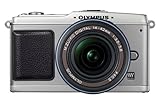
Archive for the ‘Micro Four Thirds’ Category

Panasonic Lumix GF1: micro gear, great photographic power!

Sunday, January 24th, 2010

The Panasonic Lumix DMC-GF1 is the lastest member of the Micro Four Thirds family. But before Micro Four Thirds, there was Four Thirds. With Olympus having produced relatively small film SLRs since at least the early 1970s, it was probably no surprise that they would partner with Kodak to introduce the Four Thirds System standard (with its sub APS-C sized sensor) as they prepared to move into the digital age. The smaller sensor helped the company produce diminutive DSLRs that carried on the Olympus tradition.

Sensor resolution is 12.1 megapixels and there are full manual and auto controls, plus a palette of user-established settings that rival DSLRs in number and scope. You can shoot in RAW if you choose, or RAW/JPEG combinations, and there’s 1280×720 HD video in AVCHD Lite (which is more memory efficient than Motion JPEG) or Motion JPEG formats.

The GF1 is undoubtedly smaller than its big brothers, the G1 and GH1, but it’s not quite as tiny as Panasonic might lead you to believe. Measuring 119 x 71 x 36.3mm and weighing 285g without a lens attached, it’s just a little smaller and 50g lighter than the very similar Olympus E-P1 camera. Instead of a traditional DSLR hand-grip, the DMC-GF1 has a slightly raised vertical area on the front-right which isn’t big or pronounced enough to be of much assistance. The rubberized thumb-rest on the rear is a lot more useful.

Because of space considerations inherent in the Micro Four Thirds System, a 3.0 inch LCD monitor operating in Live View is the only means of image composition and framing for capture.

If you don’t want to use the LCD screen for composition, an optional electronic external viewfinder is also available, the Panasonic DMW-LVF1 (priced at $199.95), which slots into the external flash hotshoe on top of the camera. The GF1 can record 1280 x 720 high-definition video in the AVCHD Lite or Motion JPEG formats, and it can focus in just 0.3 seconds via its contrast auto-focusing system.

The camera uses SD/SDHC memory media, and Panasonic includes a battery charger/AC adapter, battery pack, body cap, AV cable, USB connection cable, AC cable, DC cable, shoulder strap and CD-ROM software with each camera.

The Panasonic Lumix DMC-GF1 is available in four colours, black, red, silver and white, either body only (£570) or in two different kits, one with the new LUMIX G 20mm/F1.7 ASPH pancake lens, and the other with the existing 14-45mm/F3.5-5.6 ASPH/MEGA O.I.S. zoom lens: starting from US $ 866,95!
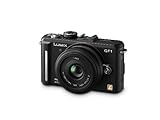
Panasonic GF1: a serious competitor for Olympus E-P1 micro four-thirds compact camera

Saturday, September 5th, 2009

The Panasonic Lumix DMC-GF1 is a 12.1-megapixel Micro Four Thirds camera, which offers a more compact form factor than its predecessors, the G1 and GH1. The Lumix GF1 looks more like the Olympus E-P1; however the GF1 also offers a pop-up flash, a feature that I sorely missed on the Olympus E-P1.

The Panasonic Lumix DMC-GF1’s Venus Engine HD records stunning high-resolution 12-megapixel images using its advanced Live MOS Sensor. This sophisticated LSI circuit separates chromatic noise from luminance noise and applies the optimal noise reduction to each, helping to capture clear and beautiful images even when shooting at high ISO levels.

The Panasonic Lumix DMC-GF1 also comes fully-equipped with a built-in flash and a large, 3.0-inch Intelligent LCD with a wide viewing angle and a 460,000-dot resolution. The Intelligent LCD offers automatic backlight control, which when combined with its high-resolution, helps improve visibility in all light environments – from sunny outdoors to low-light interior settings.

New for the LUMIX G Series, the Panasonic Lumix DMC-GF1 is compatible with an optional Live View Finder (DMW-LVF1), which provides the full-time live view function boasting 100% field of view regardless of the attached lens. To further expand the LUMIX G Series system, Panasonic Micro Four Thirds digital cameras can be used with Four Thirds System interchangeable lenses via an optional mount adaptor DMW-MA1 and with the prestigious Leica M/R lenses using Panasonic’s DMW-MA2M DMW-MA3R. These adapters give the user access to the unlimited number of lens properties.

The Panasonic Lumix DMC-GF1 will be available in early October 2009 with the option of two kits – both with a suggested retail price (SRP) of $899.95. One kit option includes the newly-announced LUMIX G 20mm/F1.7 ASPH, a compact and lightweight “pancake” lens, while the other kit features the LUMIX G VARIO 14-45mm/F3.5-5.6 ASPH/MEGA O.I.S. The optional Live View Finder DMW-LVF1 has an SRP of $199.95; while the DMW-MA2M and DMW-MA3R both have an SRP of $249.95. All new accessories will also be available in early October.

Olympus E-P1 Micro Four Thirds Rangefinder-style Camera First Thoughts and First Specs

Wednesday, July 1st, 2009

Olympus has introduced their first Micro Four Thirds camera - the Olympus PEN E-P1.

The compact new Olympus PEN E-P1 has a 12.3-megapixel sensor and it’s Olympus’ first changeable lens camera to offer a movie mode (720p HD).

The Micro Four Thirds format was announced last August and since then we’ve been anxiously waiting to find out what Olympus would do with it. Panasonic has introduced two Micro Four Thirds cameras, the Lumix G1 and the GH1 with HD video. But until now, the only Micro Four Thirds action we’ve seen from Olympus was behind glass at tradeshows. But now there’s an Olympus Micro Four Thirds camera we can bank on - and it’s not just a list of specs and features, either.

Olympus PEN E-P1 Micro Four Thirds Digital Camera

The Olympus PEN E-P1 was named in honor of the fiftieth anniversary of the Olympus Pen half-frame film camera. The lines of the E-P1’s sleek metal body are an obvious nod to that heritage. And like the Olympus Pen-Series, the Micro Four Thirds format E-P1 offers high-performance in a smaller camera body. Basically, the Micro Four Thirds format eliminates the SLR mirror so the camera and lenses can be smaller and lighter (for more on the Micro Four Thirds format, read our Micro Four Thirds Introduction article).The Olympus PEN E-P1’s stainless steel and aluminum body is comparable in size to a 35mm rangefinder and has a solid, metallic feel that traditionalists will love. Unlike the Panasonic Lumix G-Series Micro Four Thirds cameras, which have electronic viewfinders (EVF), the Olympus E-P1 only uses only a 3-inch, 230k-pixel LCD for viewing and composing, allowing them to make the camera even smaller. That allowed Olympus to make the E-P1 the smallest 12-megapixel digital camera with changeable lenses. It’s as if you chopped the top off one of the smallest digital SLRs and then squished the body front to back (see below). Lens diameters are also smaller and less glass makes the camera even lighter. The Olympus PEN E-P1’s size feels closer to high-end compacts like the Canon G10 than a digital SLR. But the EP-1’s 12-megapixel Four Thirds sensor is much larger than the G10’s and can deliver far better image quality.

There is one detail to note about image quality – the new True Pic V image processor is supposed to have a significantly better signal-to-noise ratio and that should mean better high-ISO image quality (the E-P1 maxes out at ISO 6400). Since the Four Thirds sensor is smaller than APS-C sensors in most DSLRs, it’s a bit much to expect the E-P1 (as well as Four Thirds digital SLRs) to match their image quality. The E-P1 has an image-stabilized sensor so image stabilization is available regardless of the lens you use.

If you’ve got Leica M-rangefinder lenses you can get a Micro Four Thirds M-mount adapter and you’ll be able to shoot image-stabilized photos with Leica glass on the E-P1.

Excellent reference to the Olympus E-P1 can be found here:

The Olympus PEN E-P1 is available for ordering now and is priced US $ 799.99.


All products names and icons are trademarks of their respective holders.
SourceCrowd.com is not responsible for the availability and correctness of the information provided
nor responsible for any damage that may occure to your equipment or you by using the published information.